
Festive Overture
Paul Creston
Festive Overture, Op. 116 is a late-career concert band composition by American composer Paul Creston. Written to commemorate the 50th anniversary of the American Bandmasters Association, the piece was officially completed and premiered on March 4, 1981, by the United States Army Band under the direction of Lieutenant Colonel Gilbert Mitchell.
Paul Creston (born Giuseppe Guttoveggio; October 10, 1906 – August 24, 1985) was a prominent, self-taught Italian-American composer of classical music and a celebrated organist. Emerging as one of the most widely performed American Neo-Romantic composers during the 1940s and 1950s, Creston built an expansive catalog of over 120 compositions known for their melodic richness, accessible tonality, and driving rhythmic vitality. He is especially known to saxophonists for his standard repertoire contributions in the Sonata for Alto Saxophone and Piano, Op. 19 and his Concerto for Alto Saxophone and Band, Op. 26.
Symphony No. 6 for Band, Op. 69
Vincent Persichetti
The Symphony for Band was commissioned and premiered by Clark Mitze and the Washington University Band at the MENC Convention in St. Louis on April 16, 1956. According to the composer, it could have been titled Symphony for Winds, following, as it did, his Symphony No. 5 for Strings. Persichetti, however, did not wish to avoid the word “band,” which he felt no longer had the connotation of a poor quality of music. In the autumn 1964 Journal of Band Research, he wrote, “Band music is virtually the only kind of music in America today (outside of the ‘pop’ field) which can be introduced, accepted, put to immediate and wide use, and become a staple of the literature in a short time.” According to Jeffrey Renshaw, “The Symphony for Band ... was in many ways such a departure from the established concepts of band works that it influenced the attitudes of generations of composers.”
The four movements (Adagio allegro, Adagio sostenuto, Allegretto, and Vivace) have forms with traditional implications. The opening horn call and a following scale-wise passage in the slow introduction become the two principal themes (in reverse order) in the subsequent Allegro. The standard exposition, development, and recapitulation of sonata form are the Allegro, although the traditional key relationships are not completely retained. The slow second movement is based on Round Me Falls the Night, from the composer’s Hymns and Responses for the Church Year. The third movement, in trio form, serves as the traditional dance movement and is followed by a finale in free rondo form, which draws the thematic material from the preceding movements and concludes with a chord containing all 12 tones of the scale.
The composition is in four movements:
I. Adagio; Allegro
II. Adagio sostenuto
III. Allegretto
IV. Vivace
Vincent Persichetti (June 6, 1915 – August 14, 1987) was a highly prolific American composer, virtuoso pianist, organist, and music educator who stood as a central figure in 20th-century classical music. Celebrated for his mastery of diverse musical idioms, he successfully combined elements of Classical, Romantic, and Modernist styles into what he called "graceful" and "gritty" textures. Over his lifetime, he published more than 120 works across nearly every musical medium.
On the Mall
Edwin Franko Goldman
This sing-along/whistle-along march was written in 1923 for the dedication of the Elkan Naumberg Bandshell in Central Park. The title derives from the park's spacious mall, where the bandstand is located and where New Yorkers enjoy gathering to listen to concerts. The march was composed and arranged in collaboration with Mayhew Lake in 1923 and rearranged by Erik Leidzén in 1937. Richard Franko Goldman (a well-known composer is his own right) stated in a letter that his father "did not think much of the march at the time and was astonished that it became the most popular of all of his compositions." In January 1956, Goldman conducted this march as an encore at the Nels Vogel Clinic in Moorhead, Minnesota. It was the last piece he would ever conduct.
Like many of Goldman's other marches, On the Mall has explicit expression marks, including staccato quarter notes and accented half notes. In his book Band Betterment he was rather insistent on another point: he wanted his marches played at a tempo between 120 and 128 beats per minute.
Motu
Christopher Buchanan
Motu was written for the Midwest Clinic at the request of Capt. Kenneth Collins, and we are honored to present the world premiere performance of this exciting addition to the wind band repertoire. The title comes from the Latin term meaning "of motion" and was inspired by Buchanan's interests in running and pop music. In his words:
The only time I can think is when I'm moving. To this end, I've also been influenced by the process and pulse-based music of Steve Reichand Terry Riley, as well as Zack Browning, one of my professors at the University of Illinois, who encouraged me to embrace my first love, popular music, in more classical forms of composition.
I also endeavored to explore .. the nature of motion, at least in my own experience. In some sections, the motion itself acts as the primary force driving the work forward. During others, overlapping, independent lines written in phase impart a sense of stillness to the work, the goal of which being to completely obscure the pulse. Given all the factors above stated, not only do I find myself most able to concentrate while I'm in motion, but it's frequently the time I feel most at peace.
- Program Note from United States Navy Band concert program, 19 December 2022
Spacious Skies
Bruce Broughton
Spacious Skies (2017) was commissioned and recorded by the United States Air Band in Washington. D.C.. An exuberant piece, it features a saxophone quartet as a solo ensemble with the band as accompanist.
The phrase “spacious skies” comes from the song, America the Beautiful (“Oh beautiful for spacious skies . . .”), but does not have any programmatic connotation or association other than to convey the sheer exhilaration of flying, especially as described in the words that follow the opening line, “O’er amber waves of grain, For purple mountain majesties Above the fruited plain! . . . From sea to shining sea!”
- Program Note from University of North Texas Symphonic Band concert program, 13 February 2018
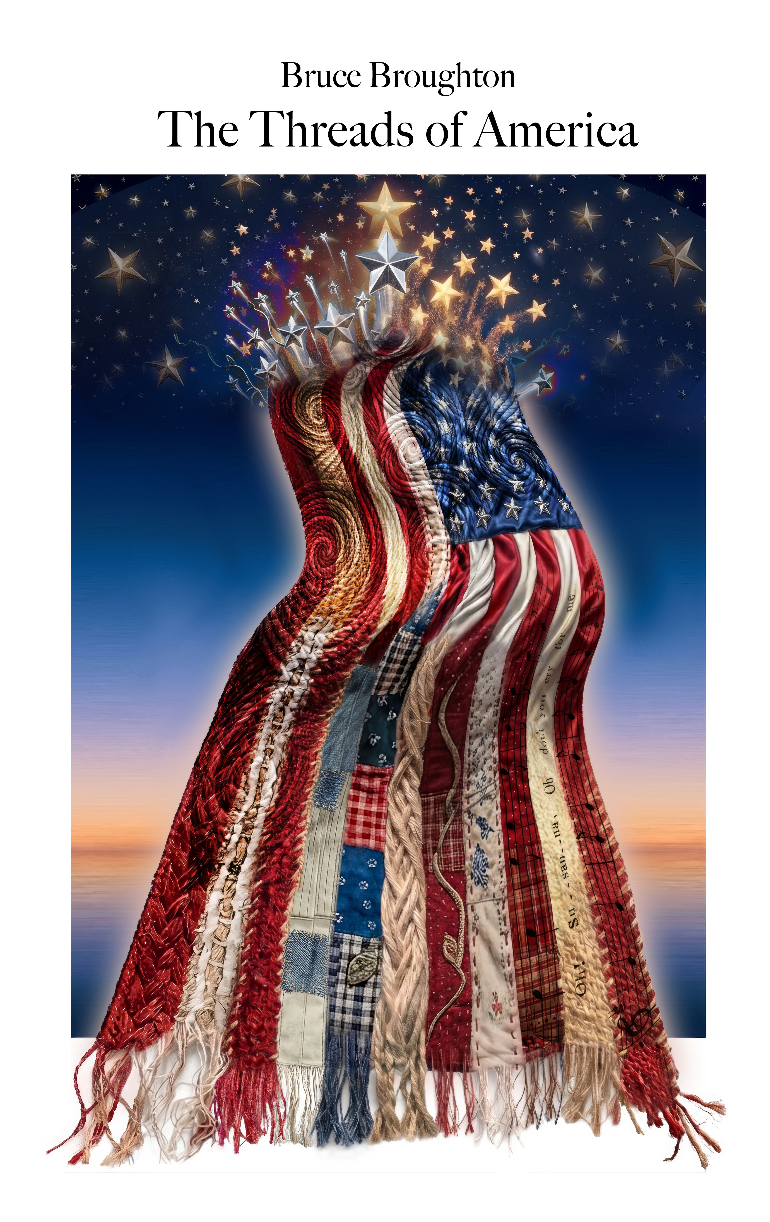
The Threads of America
Bruce Broughton
** GEORGIA PREMIERE **
The Threads of America is a brief tour through many of the musical influences that combined and developed into what would eventually be considered "American music." The piece begins with a strong fanfare followed by an energetic introduction to a strong, positive theme that represents America. References to the introduction and the theme are interspersed throughout the piece, a reminder that the musical styles and cultural references are a part of the many developmental threads in this eclectic national fabric.
Several songs from different cultural sources follow. These are the threads. The songs have either been "mashed up" to provide an entertaining and thoughtful reference, or used in abbreviated form. The first song is "The Girl I Left Behind Me," originally an Irish tune adopted by the British and brought to the Americas, where it was quickly picked up by the American colonists. The next song, "The White Sombrero" (El Sombrero Blanco), originated in Mexican California before it became a state. A quick and quiet reference to "O Susanna" leads to "Jeanie with the Light Brown Hair," a beautiful melody with an Irish influence by American-born songwriter Stephen Foster. After a brief reference to the opening theme, we hear a combination of the Negro spiritual "Sometimes I Feel like a Motherless Child" with the America theme, a reminder of how spirituals often blended African musical traditions with European hymns.
A brief return to the energetic episode from the beginning of the piece leads to a precursor of American jazz, the piano rag "The Entertainer," composed by the famous African-American composer and pianist Scott Joplin. The last quoted song, "Alexander's Ragtime Band," is by the extraordinary American songwriter Irving Berlin, a Jewish immigrant from Russia.
From this point to the end, after highlighting many threads, the piece celebrates the idea of "the fabric of America": e pluribus unum ("one from many"), the unofficial motto of the United States. A short coda brings the work to a confident close and an affirmative finale.