
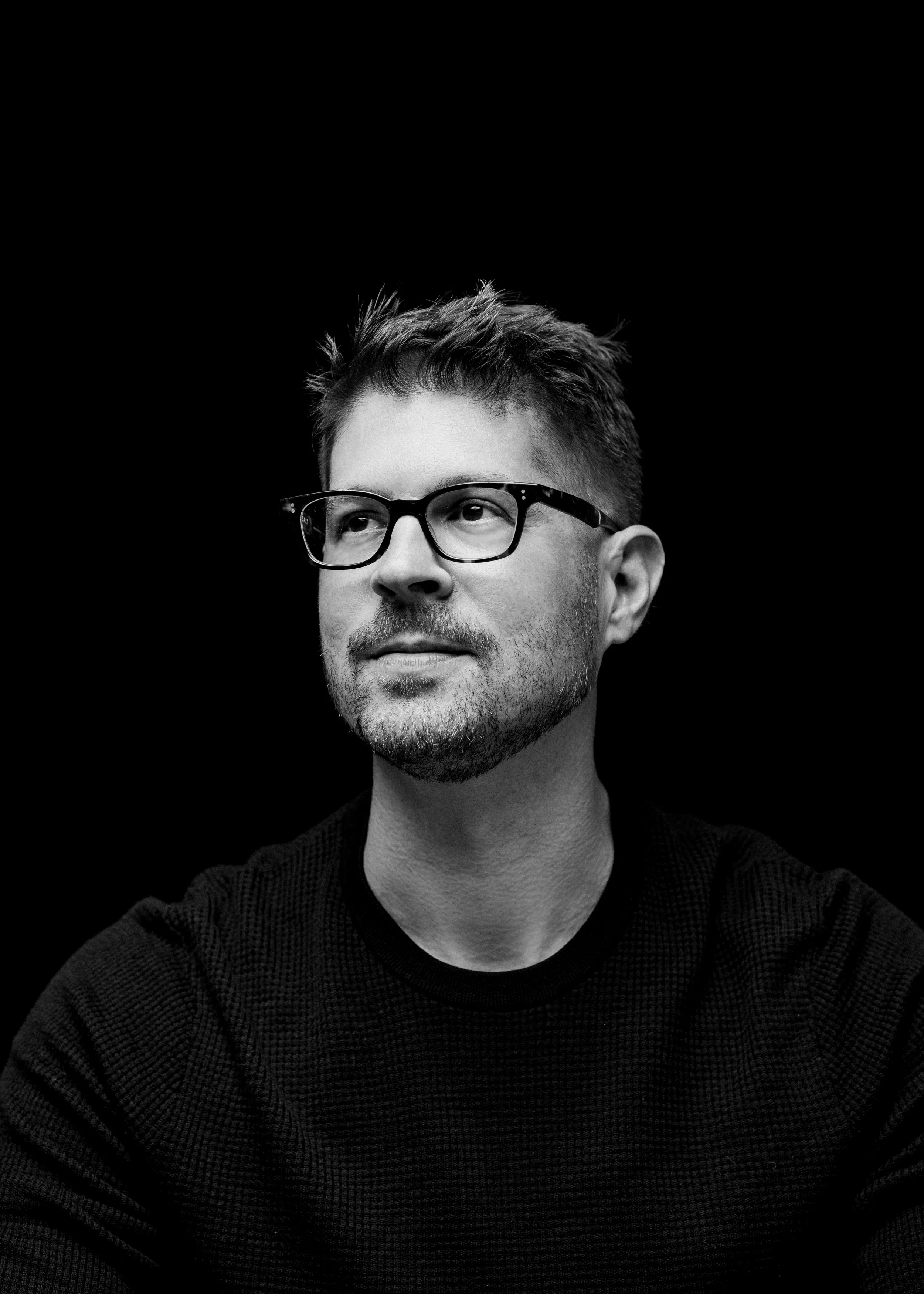
Composer Adam Schoenberg
American Overture for Band
Joseph Willcox Jenkins was born in Philadelphia and started composing at the same time he began taking piano lessons as a young boy. He studied formally with composer Vincent Persichetti at the Philadelphia Conservatory of Music while simultaneously pursuing a pre-law degree at the nearby St. Joseph’s College. Further musical studies followed at the Eastman School of Music in Rochester, New York, where Jenkins earned both bachelor’s and master’s degrees and counted among his mentors more luminaries of American classical music, including Howard Hanson and Bernard Rogers.
Jenkins embarked on his professional career by joining the military and serving on the arranging staff of the U.S. Army Field Band at Fort Meade, Maryland. With the goal of showcasing the superb horn section of that band, Jenkins composed his American Overture in 1953. It has since become one of the most often performed works in the concert band repertoire.
Jenkins went on to serve as chief arranger of the U.S. Army Chorus at Fort Myer, Virginia, and in 1961 he joined the faculty of Duquesne University in Pittsburgh, where he taught until his retirement in 2000.
PERCY GRAINGER SET
I’m Seventeen Come Sunday
Originally scored for chorus and brass band, I'm Seventeen Come Sunday was written in 1905 and is dedicated to Edvard Grieg. It is No. 8 of Percy Grainger’s British Folk Song Settings, and represents some of his earliest folksong collecting. In Larry Daehn’s arrangement the voicings and harmonies have been faithfully preserved for wind band.
Early One Morning
Two Grainger Melodies arranged by Joseph Kreines contains two of Percy Grainger’s most poetic and richly textured inspirations. The first, Early One Morning, begins with a rather somber setting in minor key, abruptly changing to the sunnier mood of the major, featuring several different solo voices. The folk song is a poignant setting of the traditional English folk song about a maiden mourning her lost love.
Arrival Platform Humlet
The Arrival Platform Humlet is a characteristic ‘Graingerism’. Composed in the same period as the The Sussex Mummers' Christmas Carol, it is scored for any of the following: solo viola, a group of violas, an oboe, cor anglais, bassoon, or a group of these instruments -- or, further, by a solo voice or unison chorus. Grainger himself put it like this: ‘Originally conceived for middle-fiddle single, or massed middle-fiddles, or double-reed single, or massed double-reeds, or as a humlet for a single voice or chorus of voices.’ This, then, gives the clue to the extraordinary title.
Grainger goes on to describe what he means: "Awaiting the arrival of a belated train bringing one’s sweetheart from foreign parts: great fun! The sort of thing one hums to oneself as an accompaniment to one’s tramping feet as one happily, excitedly, paces up and down the arrival platform." This ‘humlet’, or little hum, was apparently written in Liverpool Street and Victoria Stations, London, in 1908.
Cool Cat
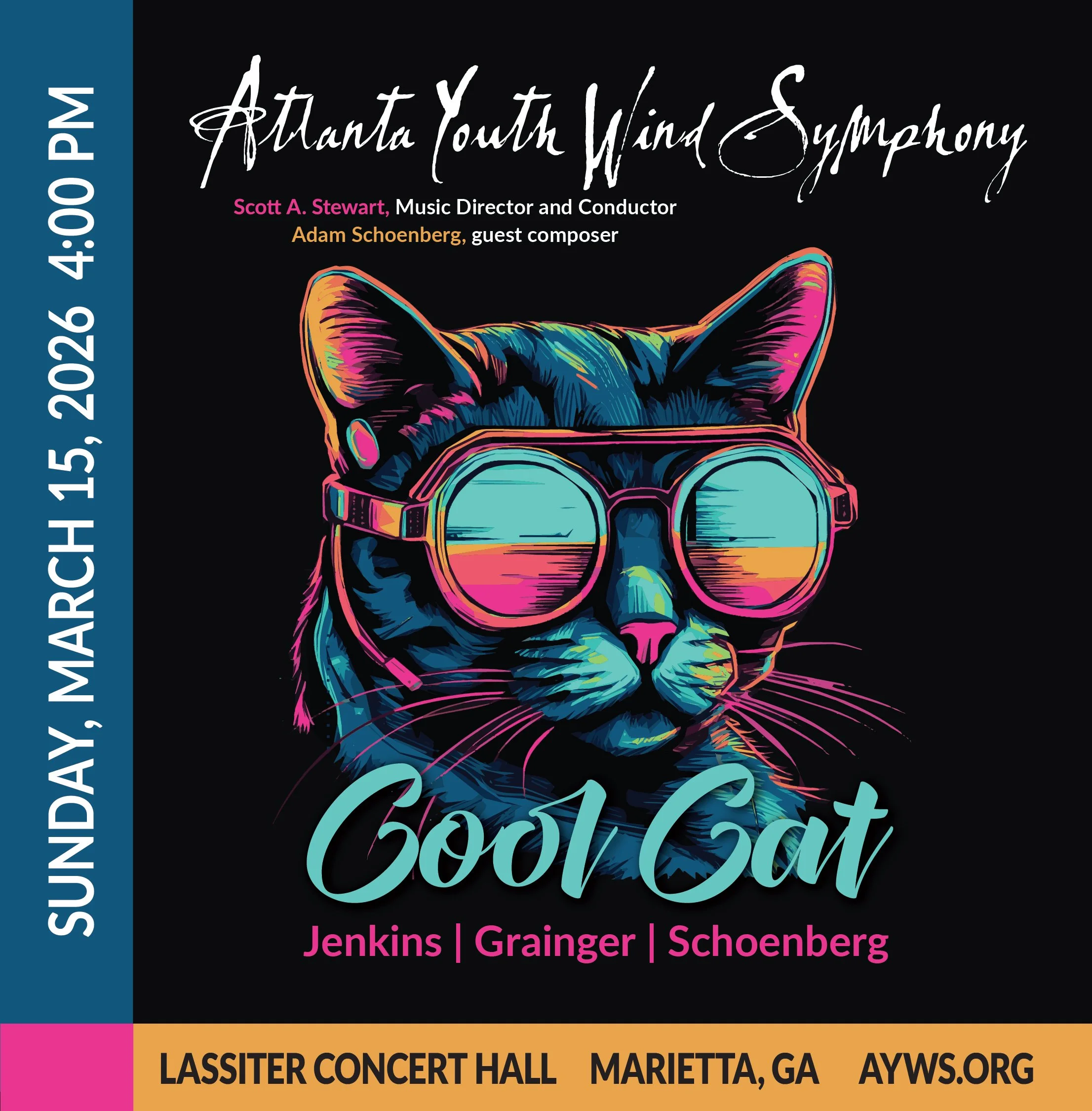
Cool Cat is inspired by the extraordinary life of P-22, the mountain lion that captured the heart of Los Angeles and beyond. This playful and celebratory concert-opener, aka fanfare, is meant to get the party started.
We knew that this work would be premiered on September 12, 2023. Serendipitously, that date falls exactly 10 years to the day when the orchestra premiered my first commission for the LA Phil. At the time, I was asked to write a children’s ballet, which I titled Bounce. That work was dedicated to my then one-month-old, Luca. My youngest son, Leo, had yet to have a piece solely dedicated to him, so I knew it was only fitting. He is fierce and determined, just like P-22! This new piece is dedicated to Leo, our very own cool cat.
- Adam Schoenberg
P-22 (c. 2009/2010 – December 17, 2022) was a wild mountain lion who resided in Griffith Park in Los Angeles, California, on the eastern side of the Santa Monica Mountains. P-22 was first identified in 2012 and was the subject of significant media attention, including numerous books, television programs and other works of art. P-22 was often recorded prowling in the Hollywood Hills neighborhood of Los Angeles. He was monitored by a radio collar.
P-22 remained in Griffith Park for ten years until he was captured on December 12, 2022. He was then euthanized on December 17, 2022, after examinations revealed he was suffering from traumatic injuries consistent with being hit by a car, in combination with several longer-term health issues.
Rise
Rise is a two-movement work commissioned by the California Wind Band Consortium. I wanted to create a new piece that could be presented in three distinct ways: Both movements played back-to-back; standalone movements (Beginnings can be a concert opener or encore, and Farewell Song can be placed anywhere in a program); or having the movements bookend an entire program (i.e., the concert begins with Beginnings and closes with Farewell Song.)
Beginnings is designed to function as a long gradual crescendo. It begins with a rhythmic ostinato that becomes the driving force for the entire movement. As it progresses, the orchestration and overall intensity grows, ultimately creating an uplifting and optimistic ending.
--Adam Schoenberg
American Symphony
Cast in five movements, American Symphony is approximately 25 minutes in length. This work would not have been made possible without the support and guidance from Frank Byrne, Janine Salinas, Robert Spano, Michael Stern, and my father, Steven Schoenberg. The work is dedicated to my family.
Movement I is a fanfare, which introduces material that will be explored in the last movement. It is built on major and minor 3rds that travel in parallel motion throughout, while constantly modulating upward. I wanted to create a succinct, swift, and uplifting prelude that projects the emotions that will be captured at the end of the journey. The final climax of movement I ends with the strings playing a harmonic cluster that fades into the beginning of movement II.
Movement II begins attaca and is conceived as an atmospheric movement. Movement II marks the start of the symphony’s emotional journey by capturing the struggle, pain and need for change. It features the flute playing a mysteriously chromatic, yet tonal, solo that hovers above pedal tones played by strings and winds. Approximately half way through, a chorale is introduced, and eight chords are played and repeated three different times before the movement ends. These eight chords are later developed in movement IV. The end of the movement introduces major triad chords in their most open form (e.g., C-G E) that move in parallel motion. This acts as a bridge to movement III.
Movement III also begins attaca and is the only movement that follows a traditional form. It is written in rondo form (ABACADA) and is built on major triads that play a rhythmic motive. I call this “happy music.” Influenced by electronica, my goal is to create a strong pulse that resembles club-like beats.
Movement IV pays homage to great American composers such as Barber and Gershwin. It is an adagio movement that acts as a prayer, with the chorale heard in movement II becoming the main compositional material for the entire movement. This movement features solos by oboe and clarinet, with subtle interactions provided by the flute, vibraphone, horns, bassoons, and trumpets. This movement is dedicated to those lost in 9/11, hurricane Katrina, and all victims of violence and war.
Movement V is the longest movement, and is essentially conceived in three larger sections: Stars, Stripes, and Celebration. The first section, Stars, contains a spiraling motive (i.e., an ostinato that transforms itself throughout the section) played by violins and orchestrated with winds. The flutes enter, playing a melody that reminds us of the opening melody in movement I. The section continues to evolve and becomes more rhythmic with added brass chords, before winding down to a chordal section introduced by the horns and celli. Stripes is announced with a strong driving pulse and a rhythmic motive played by the winds and strings. The form of this section is perceived as ABABC, where the A sections represent the initial material represented in the winds and strings. The B sections can be perceived as a classical interpretation of electronic dance music in 30 seconds. A chord progression that is built on quartal/quintal harmonies (Perfect 4ths and 5ths) with an aggressive series of arpeggiating 16th notes will be heard. The C section expands on the running 16th notes found in section B, but this time they are running more linearly. These fast running lines played by the strings will be interacting with a number of rhythmically jagged and angular chords built on major and minor 3rds from movement I played by the brass and winds. This C section acts as a bridge to Celebration. In this final section, the running parallel 8th notes in major and minor 3rds return, and a soaring melody is soon announced. The melody continues to grow until it fades away into the final episode. The violins are playing an 8th note ostinato, and new rhythmic layers are slowly being added to create a canvas of sound that is harmonically open. The final sounds played by the horns and brass represent the culmination of the musical journey, and aim to express further optimism and hope. The symphony ends suspended in mid air to remind us that even though we are making positive strides to being a better America, we are still searching. Although this American Symphony has come to an end, the journey that we take as human beings continues to move forward.