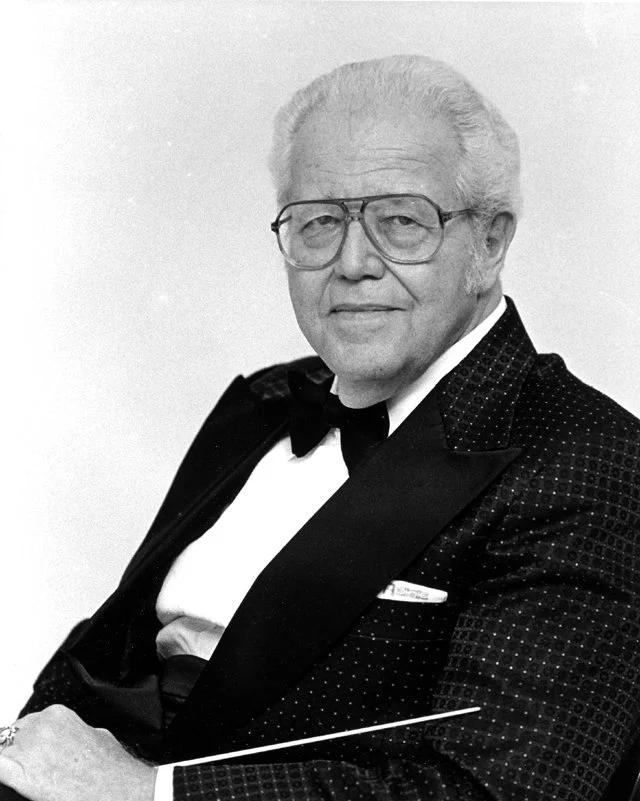
CELEBRATION
The composer notes, "Celebration—now published as A Celebration Overture—begins with a distinctive fanfare motif from the trumpets, horns and percussion, followed by the remainder of the brass and finally the full ensemble. The opening motif forms the basis of the piece that follows, albeit in several variations. A contrasting lyrical section appears shortly after the opening statement and once again before the final push to the end. The general feeling of the piece is exuberant and ... well, celebratory!”
Bruce Broughton created the work for Dr. Thomas G. Leslie and the University of Nevada Las Vegas Wind Orchestra.
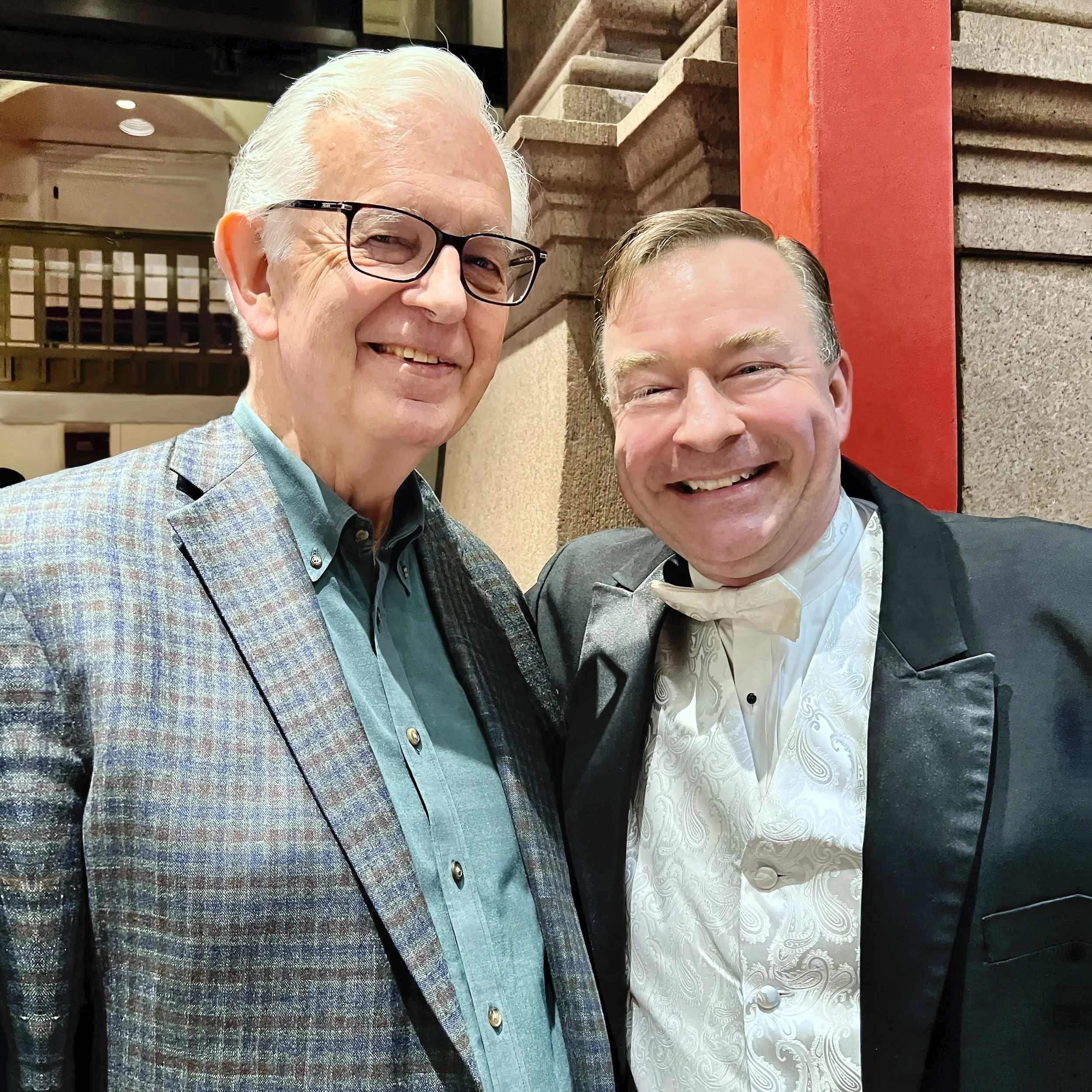
Bruce Broughton and Scott Stewart outside Carnegie Hall in 2023 following the world premiere of Grimm Tales, commissioned by and dedicated to the Atlanta Youth Wind Symphony.
ALL MY HEART
I was lying in bed one night, scrolling rather lifelessly on my phone, when I came across a video a friend had shared. It was from a taped performance at the Regional Cultural Centre in Donegal, Ireland featuring Séamus McGuire lovingly playing his fiddle and Steve Cooney tenderly accompanying on his guitar. The pair had started playing a centuries-old love song from the Petrie Collection of Irish Music called “With Her Dog and Her Gun.” As I laid there listening for the first time, something inside me stirred. I could feel my heart begin to swell. Something about this song was immediately captivating and timeless and simple and easy and familiar—like I had known it all my life. I went to bed with this recording running wild in my head, with fragments of it endlessly echoing every corner of my tired body. The next day, I listened again—perhaps to see if the magic I felt the night before was still there—and again, my heart swelled. Soon enough, I realized I couldn’t get this tune out of my head! I became obsessed with it—and the striking beauty of this performance in particular—and after a while, I felt as if it was bursting my heart wide open in a way my heart hadn’t been opened before. No other melodies or themes or songs that I had been listening to or composing myself had moved me with the magnitude that this one had. It had ingrained itself deep within me, and I was completely under its spell. Within such a short time, this beautiful Irish melody had entirely consumed me and all my heart.
AYWS is a consortium commission member of All My Heart.
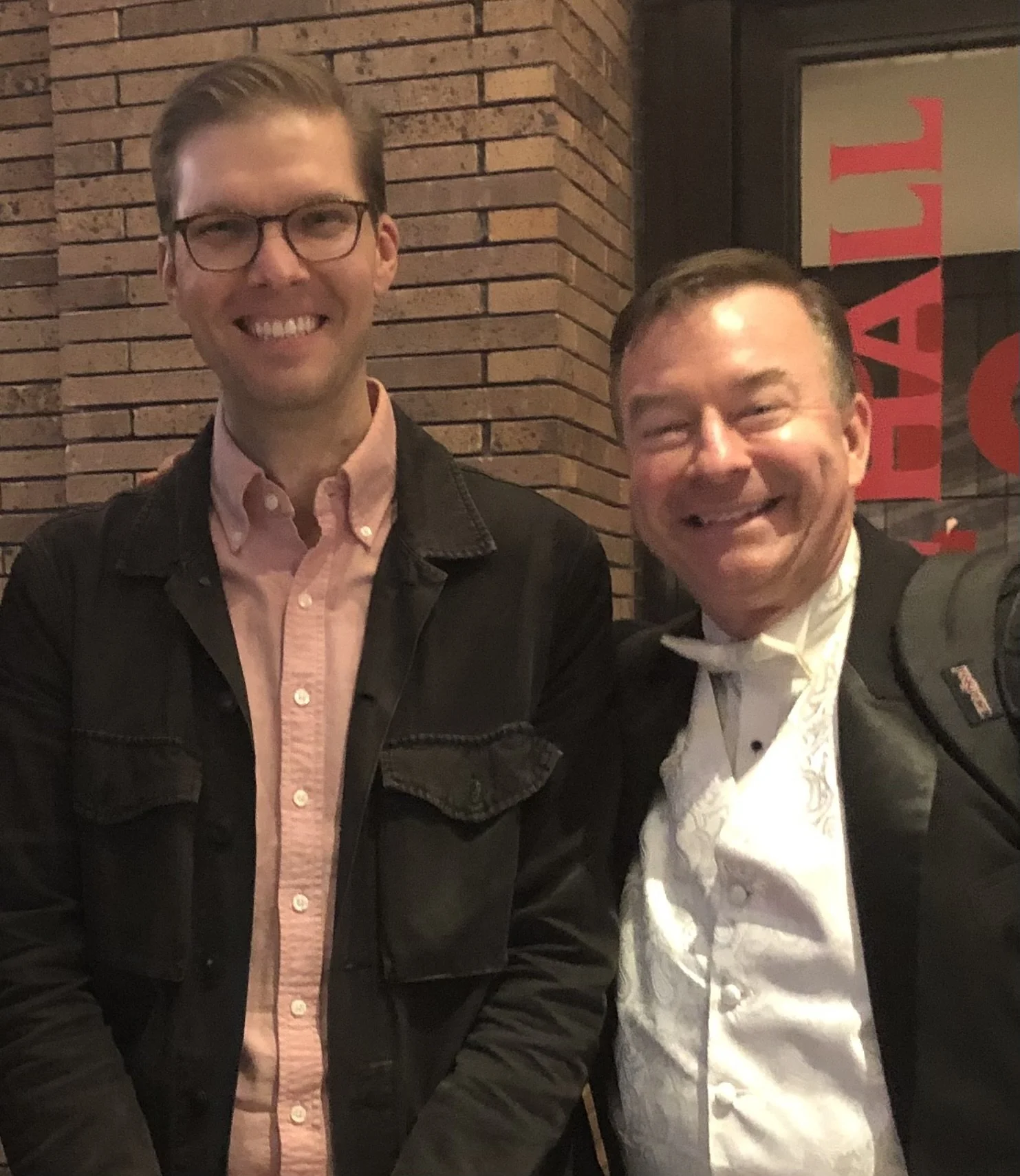
Composer Michael Markowski and Scott Stewart outside Carnegie Hall in June 2023.
CONCERTO FOR TROMBONE and WIND ENSEMBLE
The Concerto for Trombone and Wind Ensemble (originally Orchestra) was written for Rochester Philharmonic Principal Trombonist Mark Kellogg in 2003 and premiered by the Rochester Philharmonic Orchestra. It was recorded by Jim Pugh on his “X Over Trombone”CD on Albany Records in 2007 with the composer conducting the Colorado Symphony. This wind ensemble orchestration was completed in 2009 and performed in Carnegie Hall with Mark Kellogg as soloist with The Eastman Wind Ensemble, Mark Scatterday Conductor. Jim Pugh is the soloist on the concerto in the Eastman Wind Ensemble CD entitled “Joyride” a collection of Tyzik compositions to be released in October 2025.
The first movement, Prelude and Scherzo, contains antiphonal or "call and response" writing where the trombone makes a statement and the wind ensemble responds, and vice versa, in a sort of musical duel.
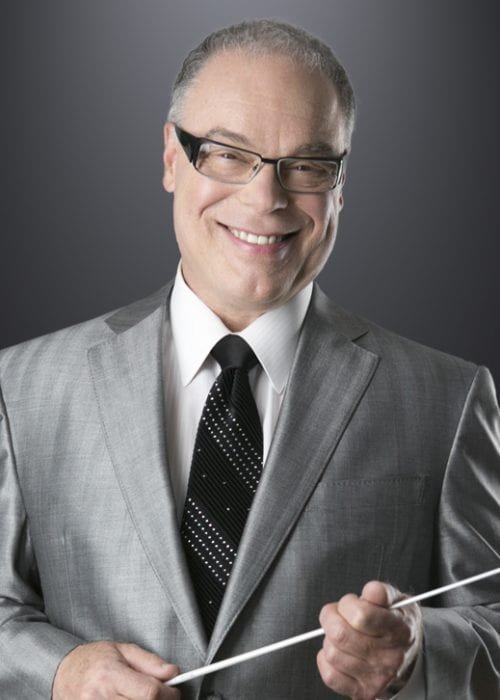
SUSPECT FOLKTUNES
Suspect Folktunes is a suite of short character pieces each based upon a tune that has folk-like qualities; that is, it could be a genuine folk tune or not. And it really doesn't matter. The subject of the tune is hinted at by its title. For example, the first tune, Napoleon at Waterloo, has a light, quasi-military character. The second, The Girl on the Green, could be a sentimental ballad recalling a nostalgic memory. The accompaniments to the melodies complement the possible content of the missing words. Each piece can be performed independently, in combination with the others, or as part of a multi-movement work. Suspect Folktunes is colorful, lyrical, and entertaining.
Suspect Folktunes was originally composed for trumpet and piano. Bruce Broughton “windestrated” the piece in 2025 and requested that it be premiered by the Atlanta Youth Wind Symphony.
RUSSIAN CHRISTMAS MUSIC
Originally written in November 1944, Russian Christmas Music was first performed in December of that year at a special concert in Denver, Colorado, by a select group of musicians from five of the leading service bands stationed in that area. Two years later the music was revised and somewhat enlarged, and in that form was one of the three prize-winning works in the 1947 Columbia University contest for new serious music for symphonic band. First performances of this second version subsequently took place in 1948: the first by the Juilliard Band under Donald I. Moore, and the second by the Syracuse University Symphonic Band under Harwood Simmons, to whom the work was dedicated. Since then this music, although not previously published, has remained in the repertory of the concert band consistently and has established the composer as one of the most important writers for the contemporary band or wind ensemble.
This published edition represents a thorough revision of the entire work by the composer in keeping with the developing instrumentation of the serious band or wind ensemble. It incorporates all of the many changes that have taken place in this area during the past years. Although the music is essentially the same, the instrumentation has been completely reworked throughout to achieve even greater clarity of texture and the utmost sonority possible. Thus we attain a degree of differentiation in the brass choirs that has come to be an accepted characteristic of the contemporary attitude toward the large-scale wind-brass-percussion ensemble.
An ancient Russian Christmas carol (“Carol of the Little Russian Children“), together with a good deal of original material and some motivic elements derived from the liturgical music of the Eastern Orthodox Church, forms the basis for this musical impression of Old Russia during the jubilant Christmas season. Although cast in the form of a single, continuous movement, four distinct sections may be easily recognized, which the composer originally subtitled “Children’s Carol,” “Antiphonal Chant,” “Village Song,” and the closing “Cathedral Chorus.” All of the resources of the modern, integrated symphonic band are drawn upon to create an almost overwhelming sound picture of tone color, power, and sonority.
Russian Christmas Music is dedicated to AYWS Supporter Program Director’s Circle members Meyoung Linda Jeung & Bongkyoung Kwan. We are grateful for your generosity!